
Insulation R-value measures how well a material slows conductive heat flow under controlled laboratory conditions, while overall thermal performance measures how well a complete assembly- a wall, an attic, a crawlspace, or an entire building envelope- resists heat transfer once thermal bridging, air leakage, installation quality, and moisture are included. For homeowners and builders in Vancouver, WA, the gap between these two numbers explains why two walls with identical R-values can feel completely different and cost very different amounts to heat and cool. R-value is one input, and thermal performance is the outcome. The right upgrade strategy depends on your framing type, climate zone, existing insulation, and whether your biggest losses come from conduction, air movement, or moisture. The sections below define each metric, compare them side by side, and show how to evaluate a home the way a building scientist would.
R-value quantifies thermal resistance: how effectively a material or layer slows conductive heat flow between its warm side and its cold side. Higher numbers mean more resistance, and the R-values of stacked layers are additive, which is part of why the industry relies on them. Under the FTC R-Value Rule, insulation manufacturers, professional installers, retailers, and new home sellers must disclose R-values based on standardized tests so buyers can compare products on equal footing.
The catch is in the test conditions. R-value testing is performed at a steady temperature, usually about 70°F, with no surrounding air movement. Because those are ideal conditions, the R-value entry on Wikipedia points out that the listed number will almost certainly be higher than what the material delivers in actual use. R-values also shift with temperature itself: a nominal R-13 fiberglass batt may perform around R-14 in cold conditions and R-12 in hot ones. And because the metric only covers conduction, it says nothing about wind washing, stack effect, or moisture in the wall.
Overall thermal performance is the assembly-level answer. Spray foam insulation in Vancouver, WA can contribute to a more complete approach to managing heat transfer across finished building assemblies. It asks how much heat actually passes through a finished wall, ceiling, or roof with all of its real materials: insulation, studs, sheathing, fasteners, wiring penetrations, and surface air films. Building scientists express this as U-factor, the inverse of R-value, and energy codes such as the IECC and ASHRAE 90.1 prescribe U-values for complete assemblies rather than for the insulation layer alone. A U-factor reflects every material in the assembly, not just the cavity fill.
| Factor | R-Value | Overall Thermal Performance |
|---|---|---|
| What it measures | Resistance to conductive heat flow in a material | Actual heat transfer across a finished assembly |
| Conditions | Steady-state lab, roughly 70°F, still air | Real weather, wind, moisture, and indoor conditions |
| Scope | One material or one layer | Framing, sheathing, fasteners, penetrations, gaps |
| Heat transfer modes covered | Conduction only | Conduction, convection, and radiation |
| Common expression | R-13, R-38, R-60 | U-factor, whole-wall R-value, blower door results |
| Blind spots | Thermal bridging, air leakage, installation quality | None; this is the full picture |
Studs, joists, and headers are parallel heat paths that bypass cavity insulation entirely. A thermal bridge is an area with higher thermal conductivity than the surrounding materials, and it reduces the overall thermal resistance of the assembly. This is why building science cited on Wikipedia shows you could double the R-value of insulation between framing members and still realize substantially less than a 50% reduction in heat loss. Continuous exterior insulation is the classic fix because it covers the framing like a blanket rather than working only between the studs.
Air moving through or within insulation carries heat with it and can trigger convective loops inside cavities. Air infiltration allows convective heat transfer or condensation formation, both of which degrade insulation performance. That is why sealing matters as much as insulating: ENERGY STAR reports that sealing air leaks and adding insulation can save up to 10% on annual energy bills. One of the primary values of spray-foam insulation is its ability to create an airtight seal directly against the substrate, which addresses the leakage that R-value alone never captures.
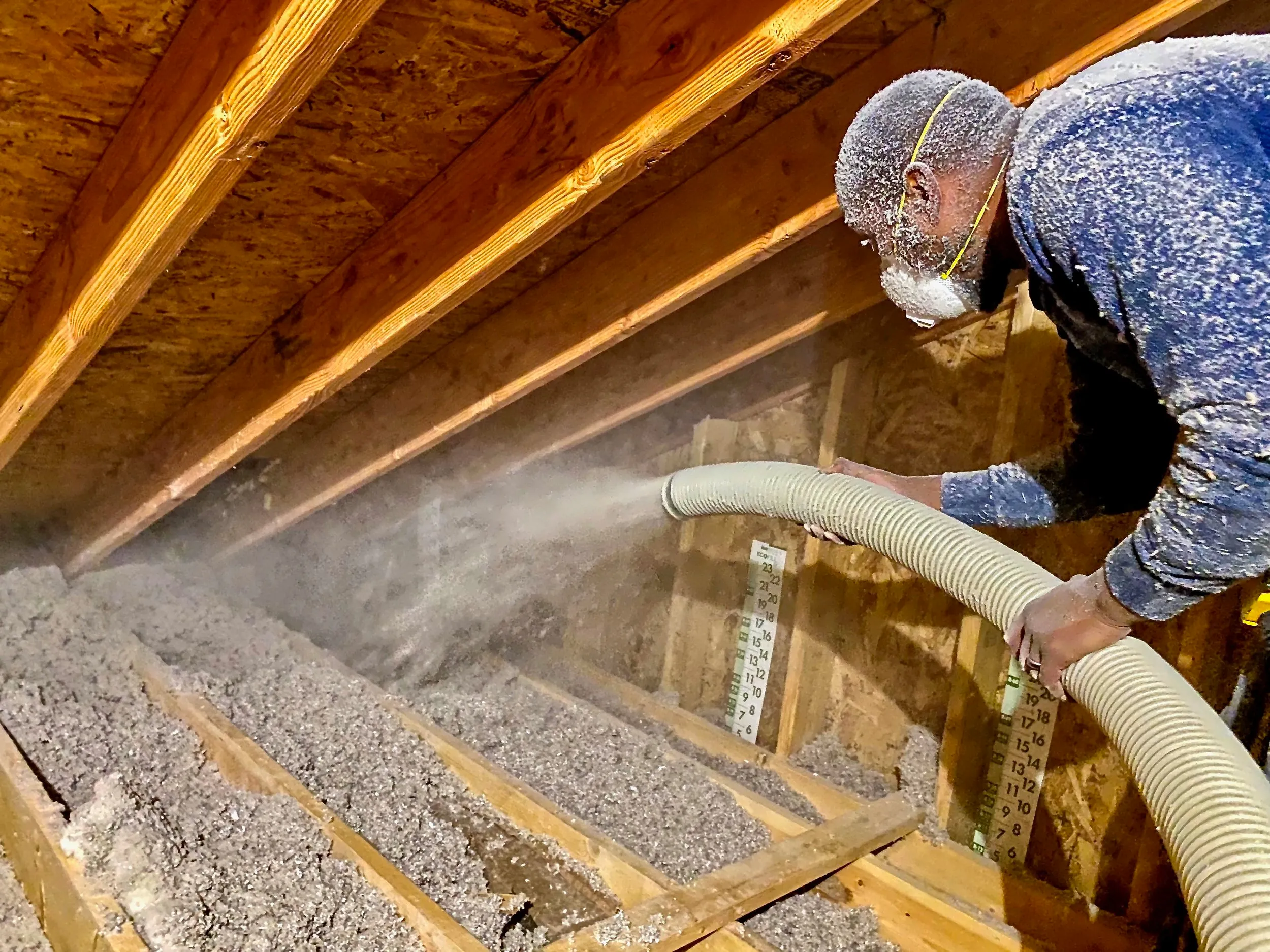
Gaps, voids, and compressed batts cut rated performance before the drywall is even hung. Loose-fill materials settle over time and create voids, and damp insulation conducts heat far faster than dry insulation. Cold spots at thermal bridges can also collect condensation in winter, which invites mold growth and further insulation degradation. The wall as installed, not the wall as labeled, determines the result.
| Project Context | Best-Fit Strategy | Why It Improves Thermal Performance |
|---|---|---|
| Rising energy bills in an older home | Air sealing plus attic insulation top-up | Stops stack-effect losses and moves performance toward the up-to-10% annual savings ENERGY STAR cites |
| New construction or full re-side | Continuous exterior insulation or foam sheathing | Covers thermal bridges at every stud and reduces air leakage at the same time |
| Crawlspace, rim joist, or band board | Closed-cell spray foam | Insulates and air-seals tight, irregular, moisture-prone areas in one step |
| Cathedral ceilings, bonus rooms, shops | Spray foam assemblies | Fills sloped or irregular cavities and limits convective loops |
| Code-compliance planning | U-factor math for the whole assembly | Energy codes evaluate assemblies, not just cavity R-values |
Reading labels is easy, but predicting how a real wall performs in the marine climate of Southwest Washington takes experience. At Supreme Spray Foam of Vancouver, our team designs insulation around overall thermal performance: continuous coverage, airtight sealing, and R-values matched to climate zone targets. Call us at (360) 300-5800 or email [email protected] to talk through your project with our crew.
Your building deserves a plan based on how it will actually perform, not just what the label promises.
Higher R-value means more resistance to conducted heat, but returns diminish once you reach climate-appropriate levels. Air sealing and continuous coverage often matter more than the last few points of cavity R-value.
Vancouver sits in climate zone 4C, marine. ENERGY STAR guidance based on the 2021 IECC recommends up to R-60 for an uninsulated attic, R-49 where some insulation exists, and R-5 to R-10 insulative sheathing when walls are re-sided.
Drafts usually come from air leakage and thermal bridging, both of which operate outside what R-value measures. Sealing bypasses at the attic plane, rim joists, and penetrations typically delivers the comfort you were expecting from insulation alone.
Closed-cell polyurethane spray foam delivers roughly R-5.5 to R-6.5 per inch. Its real advantage is that it also seals directly against the substrate, so the whole assembly performs closer to its rated value.
U-factor is the inverse of R-value and describes heat flow through a complete assembly rather than a single material. Energy codes use U-factors for walls, roofs, and windows because they capture every layer and every bridge.